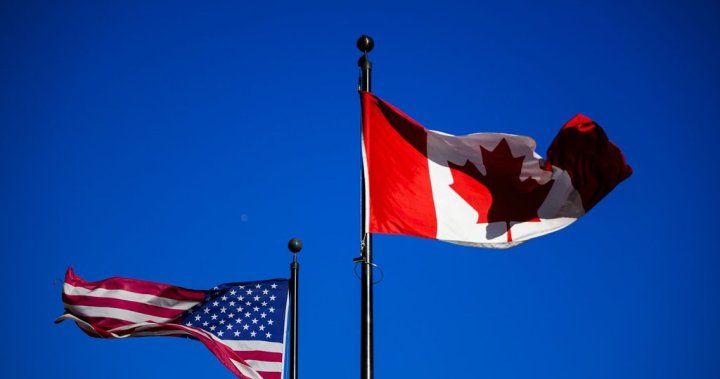
The future of the Canada-U.S.-Mexico Agreement on free trade is set to be discussed between all three countries Wednesday when a mandatory joint review will be held.
July 1 is the date set out in CUSMA for the countries to either formally extend the agreement another 16 years or continue under annual reviews for up to a decade.
A spokesperson for Canada-U.S. Trade Minister Dominic LeBlanc told Global News the minister “looks forward to meeting with his U.S. and Mexican counterparts on July 1.”
“This will be an opportunity to build on the positive, constructive bilateral discussions he has had with both countries in recent weeks,” spokesperson Jean-Sébastien Comeau said in an emailed statement.
“He is looking forward to continuing the work of supporting Canadian workers, farmers and businesses, on July 1 and beyond.”
Mexico’s Secretary of Economy Marcelo Ebrard confirmed earlier this month that the meeting will be virtual.
The meeting comes as U.S. President Donald Trump and his administration have given mixed signals about whether the U.S. will renew the agreement, renegotiate it through extended talks, or terminate it entirely.
That has created mounting anxiety for integrated sectors like the auto and manufacturing industries that rely on CUSMA’s tariff-free trade provisions, with implications for investment and the North American economy as a whole, according to experts.
“Really we need more stability. We need more certainty in this situation,” said Michael Devereux, a professor at the Vancouver School of Economics at the University of British Columbia.
Here’s what to know about Wednesday’s review and the potential paths ahead.
CUSMA came into force in all three countries on July 1, 2020, for a period of 16 years.
Article 34.7 of the agreement says a “joint review” will be held on the sixth anniversary of that enforcement date, in which representatives from all three countries will consider “the operation of this agreement, review any recommendations for action submitted by a party, and decide on any appropriate actions.”

Get daily National news
Get daily Canada news delivered to your inbox so you’ll never miss the day’s top stories.
As part of that review, each country will confirm in writing whether it wishes to extend CUSMA for another 16 years. Both Canada and Mexico have submitted letters advocating for an extension, which would take the pact to 2042.
If all three countries agree to a full 16-year extension, a new joint review will take place after another six years — in 2032.
Otherwise, if the U.S. does not confirm it wants a full extension, then a joint review will be held every year for the remaining 10 years of the original term, with the pact remaining in place as written.
At any time during those 10 years, the pact can be extended for a new 16-year term if all three countries agree to do so, again with a mandatory review in six years.
If there isn’t a consensus to agree to a full extension, then the trade pact will expire in 2036, at the end of the original 16-year term.
Any country can also choose to withdraw from CUSMA entirely with six months’ notice. If that happens, the deal would remain in place for the remaining parties unless they, too, choose to withdraw.
U.S. Trade Representative Jamieson Greer has said there are pillars of the continental trade pact that work well, but that some issues around agricultural import controls — referring to Canada’s supply management system — and rules of origin.
Those rules refer to sourcing for materials that are then traded freely across North American borders. Concerns have been raised about countries like China exploiting loopholes to get their products into the market tariff-free.
Greer has also signalled openness to two separate bilateral agreements that would replace the continental pact.
“The demands of the U.S. on Mexico versus the demands of the U.S. on Canada are quite different,” said Marc Gilbert, an international trade consultant who leads the Center for Geopolitics at Boston Consulting Group in Toronto.
Gilbert said he’s noticed a “temperature change from May of last year to May of this year,” as U.S. talks with Mexico toward the CUSMA review progressed while talks with Canada stalled.
However, he added, “We’ve seen of late that Mexico and Canada are trying to speak as one voice. Your guess is as good as mine in terms of the receptivity of the administration on that.”
LeBlanc has repeatedly said the July 1 review date is “not a cliff,” and that CUSMA will remain in place even if all three countries don’t commit to a full extension by that date.
Prime Minister Mark Carney told reporters last week that Canada won’t rush into “a bad deal” and will take the time needed to ensure a renegotiated CUSMA, as well as potential deals on lowering or eliminating sectoral tariffs, benefits all parties.
The most likely scenario, Devereux and Gilbert said, is the countries will continue negotiating improvements to the deal beyond July 1, with a longer-term extension still possible once those issues are ironed out.
“There’ll be a series of demands … and they would get into serious negotiations about their sticking points,” Devereux said.
“If we give some ground and we kind of pay homage to Trump and the U.S. a bit more, then the optimistic scenario is that we’ll get an extension — probably not the 16-year extension, but some type of certainty, some type of stability.”
Although Trump said earlier this month he wants to see CUSMA “terminated,” Devereux said this option was unlikely as many American businesses rely on the agreement just as much as Canada and Mexico do.
“U.S. businesses would be severely damaged if this happened,” he said. “They would have significant tariffs on their imports that they get from Canada. Canada would, I think, very seriously retaliate. That would be a real nuclear option.”
The prospect of a 10-year period of annual reviews also leaves open the possibility for CUSMA to be renewed under a different U.S. administration, after Trump leaves office in early 2029.
“It’s not guaranteed that even after Trump leaves office that we’ll be in a better situation,” Devereux cautioned, noting a future Republican administration could still include Trump advisors and trade hawks like Peter Navarro.
“But at least we would … know what is likely to be happening, whereas now we have no idea. It’s just at the whims of one social media writer who sends out these screeds in the middle of the night. It’s really no way to do international negotiations.”
However, Gilbert said businesses aren’t advocating or preparing for a wait-it-out approach.
“They’re not playing that game,” he said.
“There is a clear drive by USTR, by Ambassador Greer, by the administration, to make an overhaul to the current agreement. And truth be told, the wheels are in motion for that purpose.”