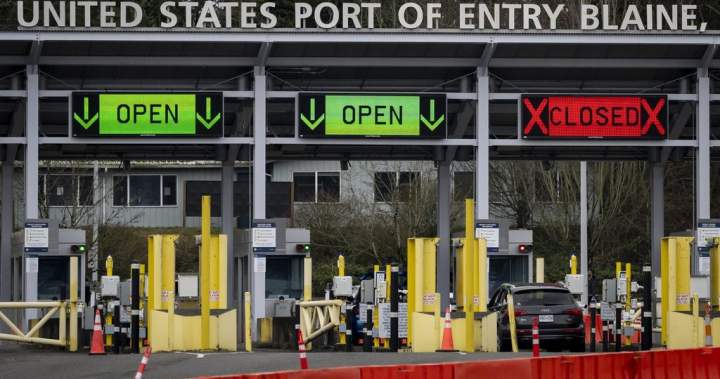
Two First Nations communities in Ontario have issued travel advisories urging caution when travelling to the U.S. and are underlining Indigenous rights under the 1794 Jay Treaty.
But what is the Jay Treaty and how does it relate to cross-border travel?
Right to freely pass into U.S.
The treaty was signed in 1794 between Great Britain and the United States and sets out that “American Indians” born in Canada have the right to freely pass into the U.S. for travel, for work or to live. They can also enter the U.S. freely for retirement or immigration.
“These rights have been identified as, it’s all of our rights as Indigenous Peoples in Canada to be able to cross the borders,” said Jessica Keeshig-Martin, acting chief of the Chippewas of Nawash Unceded First Nation. “These borders never existed; they’re fairly recent in terms of our timeline being here on Turtle Island, which we refer to as North America.”
The Chippewas of Nawash is one of the two First Nations in Ontario to issue a travel advisory in recent weeks.
In their notice, they strongly advised each member who wishes to cross the Canada-U.S. land border to carry a valid, unexpired status card; other valid information; birth certificates with parental information and/or a Canadian passport.
The First Nation said the advisory was prompted by reports of First Nation and Native American members being detained and questioned by U.S. Immigration and Customs Enforcement (ICE).

Get daily National news
Get the day’s top news, political, economic, and current affairs headlines, delivered to your inbox once a day.
“We’ve had inquiries from our members of the Chippewas of Nawash who are travelling and visiting relatives or friends, or to work and attend meetings to the south of us and so there’s definite fear,” Keeshig-Martin said. “Folks have contacted me as well, fear of being questioned and detained by ICE.”
The Assembly of First Nations confirmed last month that at least one First Nations person recently had a negative encounter with ICE and has since returned to Canada.
Indigenous people urged to carry status card and passport
In an email to Global News, Indigenous Services Canada said it was aware some First Nations “have been in contact with their band to report incidents.”
“While you may have previously crossed the Canada-U.S. border with only a secure status card, ISC now strongly recommends also carrying a valid passport when travelling outside of Canada,” the ministry said in the email.
It added that acceptance of all status cards is “entirely at the discretion” of U.S. officials.
U.S. may request proof of Indigenous status
Amid concerns over U.S. travel, Saugeen First Nation in Ontario also issued a notice that suggests “exercising caution” if going south of the border.
While it notes that Section 289 of the U.S. Immigration and Nationality Act codifies rights from the Jay Treaty, members travelling south should still carry various documents.
It says members will need proof of lawful status through several documents, including a status card, a long-form birth certificate, a government-issued photo ID, a Form I-181 or I-551 (green card) if you have one, and what’s known as a blood quantum letter.
The letter is a requirement in which Indigenous people must prove they have 50 per cent blood quantum, showing the bearer of the letter is at least “50 per cent of the American Indian race,” according to the U.S. Embassy and Consulates in Canada.
According to Indigenous Services Canada, such documentation must either come from a person’s First Nation or a letter of ancestry requested from the ministry.
The ministry adds a caution, though: “A letter of ancestry is an official document confirming registered ancestors, but, it does not list a person’s blood quantum. You may be asked for more documentation.”
The Chippewas of Nawash and Saugeen First Nation are just the latest First Nations communities to issue advisories since the new year.
Last month, the Okanagan Nation Alliance, which represents eight First Nation communities in British Columbia, issued its own, urging members “exercise extreme caution.”
“Although the Jay Treaty reaffirms our right to travel freely to and from the United States, we expect that not every federal law enforcement officer and ICE agent will be familiar with our rights to cross the border freely,” the alliance wrote in its advisory.
Alberta’s Blood Tribe Chief and Council also issued an advisory late last month urging members to use caution.
“Blood Tribe Chief and Council is urging Blood Tribe members to use caution when crossing the border into the United States, notwithstanding our inherent rights and the promises of the Jay Treaty, during the current time of political unrest,” the advisory said.
They added that Canadian federal certificates of Indian status have reportedly not been accepted as proof of blood quantum, and that such documentation must come directly from an individual’s First Nation.
The Assembly of First Nations, which has also issued its own advisory on U.S. travel, says in emergency cases, people can contact the Canadian Consulate.
© 2026 Global News, a division of Corus Entertainment Inc.