The artist behind a controversial photograph blasted as blasphemous by detractors says renewed criticism over its display in Fredericton misses the point.
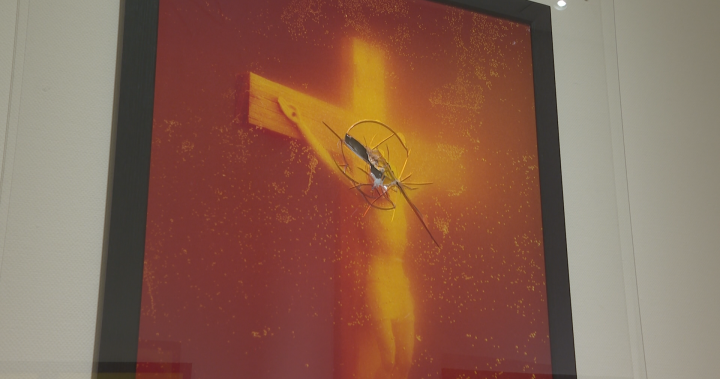
Created in 1987, American photographer Andres Serrano’s Piss Christ (Immersions) depicts the crucifix submerged in the artist’s own urine. The polarizing piece is part of a collection titled Incarnate, which is a series of photographs of Christian symbols mixed in human fluids.
“Piss Christ, if it upsets you, it should upset you because the death of Christ was very upsetting. But he died for our sins,” Serrano told Global News.
“I see is as a work of sacred art. I’m not only an artist, I’m a Christian, I’ve been a Christian all my life, and so for me, it’s a Christian work of art.”
For decades, the artwork has been divisive and has sparked controversy wherever it has been displayed.
In 1997, the Catholic Archbishop of Melbourne tried unsuccessfully to block its display, while in the U.S., conservative groups have condemned the work as offensive to Christians.
In 2011, protesters in France broke the glass by smashing it with a hammer. The shattered glass remains as part of the display.
It will now be displayed at the Beaverbrook Art Gallery in New Brunswick’s capital until Nov. 29, on loan from the Rennie Collection in Vancouver.

Get breaking National news
Get breaking Canada news delivered to your inbox as it happens so you won’t miss a trending story.
The art gallery’s executive director, Bernard Doucet, says it’s the first time the controversial piece has been displayed in Atlantic Canada.
“It’s been about 30 years since the work was last shown in a public institution in Canada,” said Doucet.
“It helps us actually as a gallery to launch a focus series around religious and ecclesiastical art.”
Doucet says he’s proud to have the exhibit in the gallery despite its controversial history.
“The experience of seeing art is a deeply personal one. Artists make things to inspire all sorts of responses or reactions from everyone that ever looks at their work, as long as it exists,” said Doucet.
‘A form of contempt directed toward Jesus Christ’
But the decision to bring it to Fredericton has met with pushback.
Saint John – St. Croix MP John Williamson said the artwork is “beneath our museum’s storied tradition.”
“I do not agree with censorship of speech, which includes the arts, nor do I agree with insulting other religions either,” Williamson wrote in an email to Global News.
“The Beaverbrook is a great Canadian museum with a world-renowned collection, but this exhibit is what you would expect from a third-rate gallery hoping to be relevant.”
Bishop of the Diocese of Saint John, Christian Riesbeck, said the Church doesn’t want to censor art or silence artists but hopes “moments like this” will launch deeper conversations about faith.
“Many Christians experience this piece not as thoughtful critique, but as a form of contempt directed toward Jesus Christ,” Riesbeck wrote in a statement.
“Even if the artist’s intention is provocation, the effect on believers matters (…) This is not simply about offence; it is about the treatment of what billions of people consider sacred.”
After decades of controversy, a professor at the University of British Columbia’s Department of Art History believes the piece still has relevance.
Christine D’Onofrio, who is also a visual artist, says the artwork can be viewed as it relates to the lack of humanity in current society.
“In its time, it had a very particular connection to the sort of the tragedy of human — substances in connection to the AIDS epidemic,” she said. “So it had a very topical connection of its time, but art always updates with the viewer.”
She adds she’s seen the piece and calls it “beautiful.”
“I’ve seen it in person and it glows,” she said.
When asked what the message was behind his piece, Serrano said, “There there is no message. That’s the message.”
“The explanation is that artists work in mysterious ways. And sometimes they are not even aware of why they do the things they do. But they know that everything comes from a core,” he said.
“I feel that it’s reignited the conversation conversation around Christianity and art, something that has not been seen in centuries.”
© 2026 Global News, a division of Corus Entertainment Inc.