


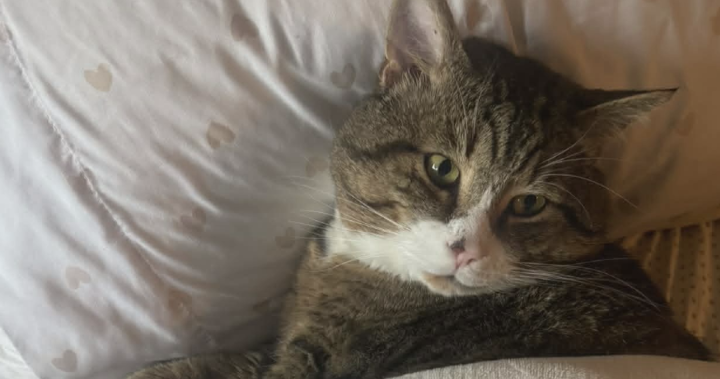
A North Vancouver family is fighting to bring their cat Simba home after he disappeared earlier this month and was later adopted by another family.
“I’ve had Simba since the day he was born, literally the day he was born,” said Simba’s original owner, Rachel Sinclair. “He’s our dog’s siblings, he’s my best friend, he’s our family member.”
According to Sinclair, Simba went missing while her dad, Robert Sinclair, was out of town.
They later learned that Simba had been found injured, brought to the Norgate Animal hospital, transferred to the West Vancouver SPCA and ultimately adopted into a new home.
“Twenty-four hours rolled around, and Simba had not come and laid on my bed, my face like he normally does, and I was concerned,” Robert Sinclair said.
The BC SPCA says Simba arrived in its care without any permanent identification.
Under provincial law, the organization says stray animals must be held for at least four days before they can be adopted.


Get daily National news
Get daily Canada news delivered to your inbox so you’ll never miss the day’s top stories.
“I look at my pets like they’re family members. If your child disappeared, would four days be enough time, if it was found?” Robert Sinclair said. “It’s not. Four days, I don’t think is reasonable.”
The organization says it kept Simba in its care for longer than the required time frame but the Sinclair family did not contact it until after the adoption was finalized.
“Once an animal has been adopted, not only do the previous owners, but also the BC SPCA loses all legal right or ownership to that animal,” BC SPCA communications senior director Kaila Wolf said.
“So, unfortunately, despite the fact that we completely understand that this situation is absolutely devastating for Simba’s previous owners, we actually are not legally able to interject or overturn that adoption at all.”
Wolf says situations involving unidentified animals are unfortunately common.
Last year, the BC SPCA received more than 5000 animals. The SPCA was unable to find the owners of 85 per cent of the cats brought into care.
“The real and a concerning part of that is it can be avoided through permanent identification,” Wolf said.
“Having a tattoo on your animal, having a microchip and very, very importantly, you need to make sure that the contact information that’s linked to that permanent identification is up to date.”
The Sinclair family acknowledges Simba did not have a microchip or tattoo and says, in hindsight, they wish he had.
“We’ve provided a good, loving home for this animal for six and a half years, and we feel like we still have the right to do that,” Robert Sinclair said. “The SPCA’s position is that they followed protocol.”
Rachel Sinclair says they are not blaming the family who adopted Simba. They are just hoping the new owners learn that he already had a family.
“There’s no anger, animosity towards you. I just want my Simba home,” she said. “We will help you get a cat that is in need of a home, because he has a home.”
© 2026 Global News, a division of Corus Entertainment Inc.