


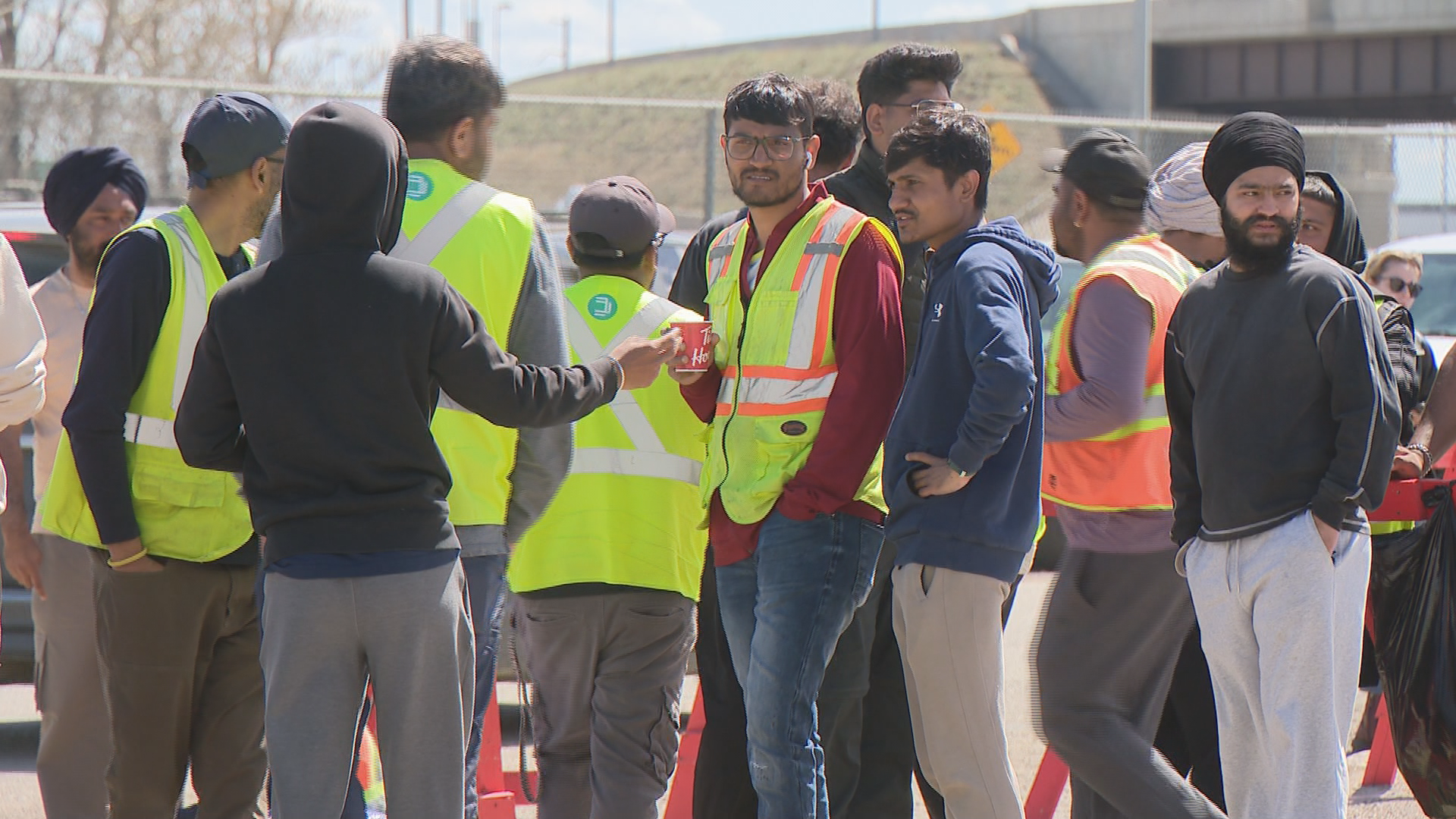
The president of a union that recently helped Uber drivers ratify a contract in Victoria, B.C., says he was contacted by contract delivery drivers in Saskatoon who walked off the job last week over what they deem unfair and unsafe working conditions.
Dozens of drivers contracted by contract delivery company Dragonfly, which handles packages for companies including Amazon, walked off the job last Friday, demanding better pay rates, more consistent scheduling and safer working conditions.
Now, these workers say they are looking to form a union to increase their collective power and negotiate better working conditions with Dragonfly.
“There is no benefit or any rights for us. So that’s why we are fighting,” said delivery driver Amrit Singh.
Barry Sawyer, national president of United Food and Commercial Workers (UFCW) Canada, says the striking workers reached out to Local 1400 in Saskatoon and to the union’s national office as their job action continues for its sixth day.
“We’re looking for ways that we can help these workers,” Sawyer told Global News in an interview.
Just last month, around 1,000 Uber drivers in Victoria, represented by UFCW Local 1518, ratified their union contract after nine months of bargaining with the company, something Sawyer said marks the first traditional collective agreement for those drivers in the country.
“We met in Victoria every time at a bargaining table, and our side was on one side of the table, Uber’s manager on the other side, and we worked through all the things that we were able to get on behalf of these drivers,” said Sawyer.


Get daily National news
Get daily Canada news delivered to your inbox so you’ll never miss the day’s top stories.
Setting up a union for gig drivers comes with many challenges, from addressing differences in bargaining demands to the difficulties of rallying precarious workers, whose membership commonly fluctuates and who lack a typical office space, said Sawyer.
Singh says he was recently let go as a driver for Dragonfly, a decision he learned of via a WhatsApp message. But it was not from the company itself, but instead from his “independent delivery contractor,” referred to as an IDC, that is hired by Dragonfly.
Dragonfly operates by letting individuals and companies sign up to become IDCs, allowing them to hire and manage a team of drivers. Singh said these individuals are their primary point of contact for receiving work and even determine their wages.
“They are just using like IDC as a middleman to just deny us our rights, our benefits, everything,” Singh told Global News, adding that when drivers attempt to contact Dragonfly, their requests are shut down.
“Whenever we raise our voice, they just say, ‘You don’t work for us.’”
Dragonfly confirms in a statement that it does not employ delivery drivers but instead works with independent delivery companies that manage drivers.
“These independent delivery companies are responsible for driver hiring, scheduling and compensation, in accordance with applicable laws and regulations,” Dragonfly said in a statement to Global News.
This business model is increasingly common in the gig economy, said employment lawyer Lior Samfiru, adding that workers hired by subcontractors are often referred to as contractors rather than employees, which impacts their legal rights.
“The reality is that a lot of these subcontractors who then hire the employees are not equipped to deal with employees because they’re really small operations themselves,” Samfiru said, adding that these business models also often lack accountability as they pass on responsibility to the next line of contractor.
While progress is being made in places such as Victoria with its Uber contract, Samfiru says non-unionized drivers should still be careful when striking, as they do not have the same rights as unionized strikers and could face legal dismissal.
“So the risk here is that for any individual, especially these Dragonfly contractors, if there are other people willing to do the job, Dragonfly and the other contractors can hire those other people and the individuals on strike will lose their jobs,” he said.
“As a strategic measure, it’s very problematic and may not be something that results in the improvement that they want, just because they may ultimately lose their job.”
However, legal options, like going through the Ministry of Labour, are still on the table.
“You can’t be punished for standing up for your legal rights to the extent that the company is breaching those rights. But you have to show, not that the company is not treating you well, you have to show that the company is actually doing something illegal,” said Samfiru.
© 2026 Global News, a division of Corus Entertainment Inc.